
Design Highlights
- High insurance premiums and out-of-pocket costs make basic health care access unaffordable for many residents.
- Rural areas in Southwest Arkansas suffer from a shortage of primary care and mental health providers.
- Transportation challenges hinder access to necessary care, especially for those needing specialist services.
- Financial instability of local hospitals threatens emergency services and overall health care availability.
- Limited broadband access restricts the effectiveness of telehealth as a supplementary care option.
In Southwest Arkansas, the concept of “fair health care” feels like trying to find a needle in a haystack. It’s supposed to mean affordable, accessible, timely, and understandable care. But for many, that’s just a lofty ideal. The reality is stark. With insurance premiums and out-of-pocket costs soaring, many residents are left grasping at straws.
In Southwest Arkansas, fair health care feels elusive, as soaring costs leave many residents struggling to find even basic access.
Employer-sponsored coverage? Great—until you lose your job. Then you’re left with gaps that Medicaid expansion could fill, but good luck getting that around here.
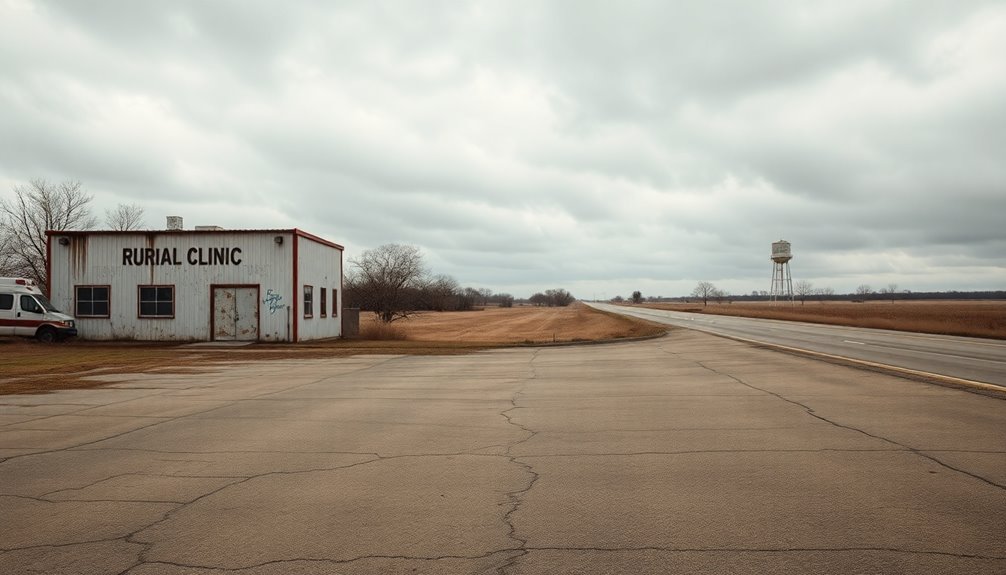
The region is largely rural, which adds to the chaos. Imagine needing a specialist but finding out that the nearest one is a two-hour drive away. And what if you don’t have reliable transportation? Good luck with that. The whole setup creates a perfect storm of barriers. Shortages of primary care doctors and mental health providers make it feel like a game of musical chairs—except there aren’t enough chairs, and the music stops too quickly.
Then there’s the ever-looming specter of hospital closures. Rural hospitals are often on shaky financial ground, operating on razor-thin margins. One little hiccup, and suddenly, the nearest emergency room is a world away. Just last year, Hope Hospital’s acquisition highlighted the fragility of healthcare in the area.
What’s that? You need a trauma center? Sorry, you might want to reconsider your life choices. When local facilities can’t handle higher-level care, that’s when the ambulance services and transfer protocols should kick in. Spoiler alert: they often don’t.
Let’s not even get started on the so-called safety-net institutions. They’re the lifeline for the uninsured and underinsured. But with their own struggles, how can they be expected to catch everyone falling through the cracks? It’s like trying to catch rain in a sieve. For those who do seek individual coverage, licensed agents provide personalized guidance through the maze of available plans, often at no cost to the consumer.
And then there’s telehealth, the shiny new toy that emerged during COVID-19. Sure, it’s a great idea, but only if you have decent broadband access. For many, that’s a pipe dream. Restoring broken health care systems can help address some of these challenges, but it requires a concerted effort to make it a reality.
Telehealth can help with chronic disease management and behavioral health, but it can’t replace the need for in-person visits. It’s not a magic wand, just another tool—if you can access it.