
Design Highlights
- Rising oil prices, approaching $100 per barrel, create economic instability affecting home-buying affordability this spring.
- Potential escalations in conflict could push oil prices to $150-$200, further straining household budgets and homebuyer confidence.
- Increased inflation, projected at 1.2%, will likely raise mortgage rates, complicating financial decisions for potential buyers.
- Disruptions in the Venezuelan oil market add to uncertainty, risking $500 billion in contracts and exacerbating energy supply issues.
- Higher healthcare costs, expected to rise 9% in 2025, further strain household finances, making homeownership less attainable.
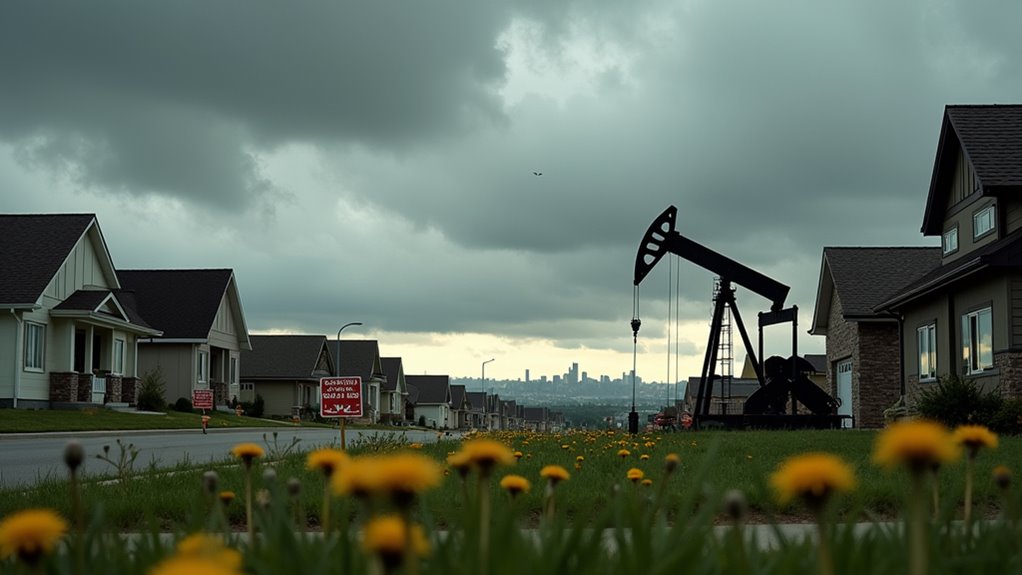
As tensions rise in the Middle East, the war threat from Iran is throwing a serious wrench into the home-buying season. Homebuyers hoping for a smooth spring are now faced with a chaotic backdrop of surging oil prices and economic uncertainty. Brent crude oil has shot toward $100 per barrel in 2026, marking the sharpest Iran-related oil shock since 2012. And if the situation escalates, prices could rocket to between $150 and $200 per barrel. That’s right, folks—welcome to the new normal.
Higher oil prices don’t just hurt at the pump. They ripple through the economy like a stone tossed in a pond. A scenario where oil hits $120 per barrel could see inflation jump by 1.2 percent. Meanwhile, economic growth might contract by 0.4 percent. This is where it gets dicey for homebuyers. Mortgage rates usually dance to the tune of inflation and growth expectations. So, with oil prices soaring, buyers might find themselves in a financial chokehold, forced to pay more for loans when they just want to buy a house. Additionally, the Iranian strategy emphasizes low-cost attacks that disrupt energy flows, further destabilizing the market.
And let’s not forget the Strait of Hormuz, the world’s oil lifeline. It carries about 20 percent of global oil and liquefied natural gas supplies. So when Iranian strikes caused tanker transits to plummet by a staggering 94 percent, the oil market went bonkers. One day, everything’s fine; the next, it’s a chaotic free-for-all. This disruption could mean $500 billion in contracts are dangling over an abyss. If this continues, energy supply disruptions will see inflation pressures rise even higher. Good luck affording that dream home!
The World Trade Organization is sounding alarms, warning that sustained high oil and gas prices could shave 0.3 percent off global GDP growth in 2026. This decline in GDP growth isn’t just a statistic; it’s a reality check. Higher energy prices make everything cost more. Materials, services, you name it. Home prices are no exception. It’s a domino effect that leaves potential buyers scratching their heads, wondering how they’ll ever afford a place to call home. Adding to the financial burden, employer-sponsored health care costs are expected to rise by 9 percent in 2025, pushing the average annual cost per employee beyond $16,000 and further straining household budgets.
In short, the war threat from Iran is casting a long shadow over this significant home-buying season. With rising oil prices and economic instability, the path to homeownership looks rockier than ever. And who knew spring could feel so bleak?