
Design Highlights
- A flood at the VA hospital construction site caused $414,000 in damages due to a defective sensor.
- The subcontractor is filing a bond claim against Liberty Mutual, shifting blame for the losses.
- Liberty Mutual’s bonds cover project completion, not flood damages from equipment malfunctions.
- The general contractor must navigate complex insurance claims while ensuring project completion for veterans.
- This incident underscores ongoing challenges in construction liability and flood risk management.
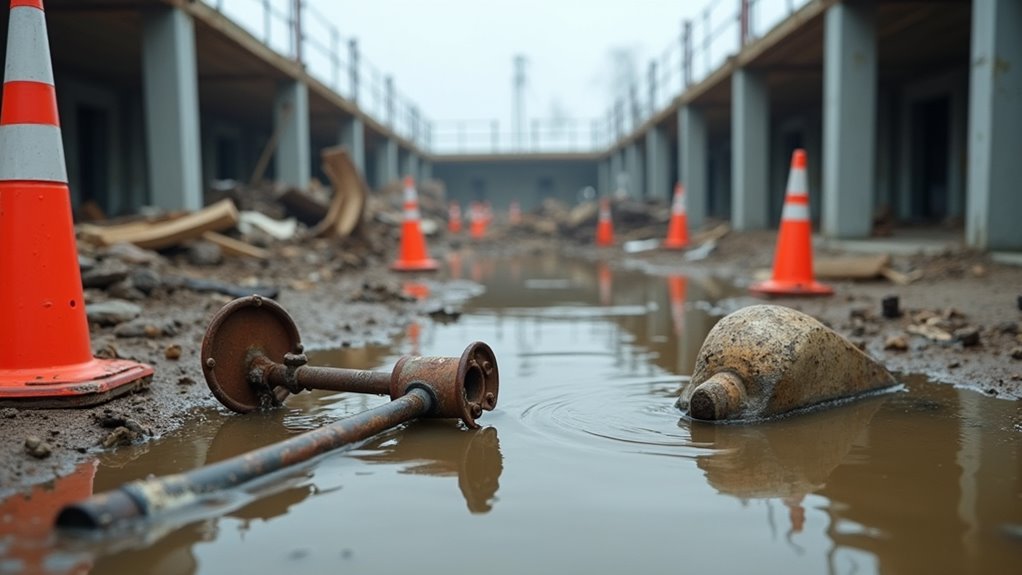
A flood at a VA hospital construction site has turned into a blame game, with a subcontractor pointing fingers squarely at Liberty Mutual’s bond. It’s a classic case of “not my fault.” The flood, caused by a defective sensor, has put a hefty $414,000 dent in the project, which is already a pricey $7.37 million federal undertaking.
So, what’s the subcontractor’s move? Filing a bond claim against Liberty Mutual, of course. Because why take responsibility when you can shift the blame?
The subcontractor’s strategy? File a bond claim against Liberty Mutual—better to pass the buck than own up to mistakes!
The subcontractor is now gunning for a payout from Liberty Mutual’s bond, hoping to recover the estimated damages from the water disaster. Imagine the scene: a construction site that was supposed to be bustling with activity, now dampened by an unexpected waterfall. The flood didn’t just ruin materials; it halted work and threw a wrench in the entire project timeline. Talk about a buzzkill.
Now, let’s break this down. The bond that Liberty Mutual provides is supposed to guarantee that projects like this one get completed on time. But here’s the kicker: the subcontractor is now claiming that the bond is somehow responsible for their losses. It’s a tangled web of blame, with the subcontractor arguing that the defective sensor wasn’t their problem. They were just the unfortunate players in a faulty game. Interestingly, this incident underscores the growing demand for comprehensive flood risk management amid increasing flood events. Liberty Mutual’s Subcontractor Default Insurance aims to protect general contractors against such performance failures.
You have to wonder how the general contractor feels about all this. They’re overseeing the work, but suddenly, they’re caught in the middle of a blame storm. Documentation such as photos and receipts will likely play a critical role in determining whether the sudden and accidental damage qualifies for any recovery under the applicable policies.
With the VA hospital project being a federal one, the stakes are high. This isn’t just another construction job; it’s about providing a facility for veterans. The urgency and importance are palpable. But instead of focusing on getting the job done, everyone’s scrambling to point fingers.
Liberty Mutual, for its part, offers surety bonds and subcontractor default insurance. But those bonds are supposed to protect against performance failures, not cover for a flooded site due to sensor malfunctions.
As the claim unfolds, one thing’s clear: the drama isn’t over. The subcontractor wants their money, Liberty Mutual has to defend its bond, and the general contractor is left wondering what went wrong.
In the end, there’s a lot of water under the bridge—and a lot of finger-pointing in the air. Welcome to the world of construction, where blame is as common as hard hats.