
Design Highlights
- Capped Rewards: Both the Obsidian and Palladium Cards limit points earned, potentially reducing overall benefits for high spenders.
- Complexity of Dual-Currency System: Managing Bilt Points and Bilt Cash can be confusing, especially for those unfamiliar with dual-reward systems.
- Annual Fees vs. Rewards: The annual fees for premium cards may outweigh the benefits, especially for non-foodies or infrequent travelers.
- Budgeting Challenges: The no preset spending limit feature might complicate financial planning and budgeting for users.
- Fine Print Confusion: Understanding specific usage rules and restrictions for rewards can be daunting, leading to a mixed user experience.
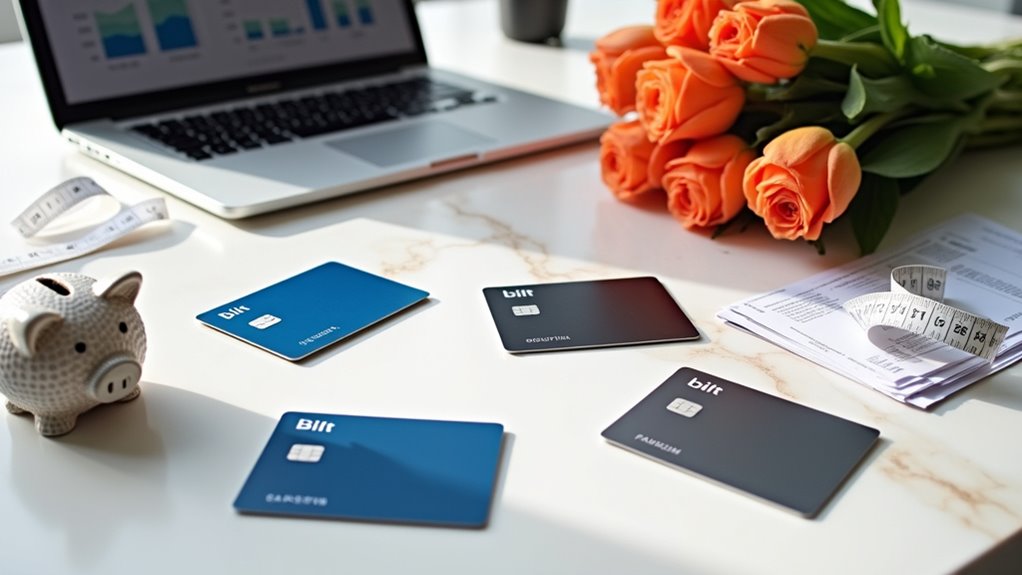
When it comes to credit cards, Bilt has thrown a few curveballs that are hard to ignore. First off, let’s talk about the Bilt Blue Card. Zero annual fee? That’s a win. But then there’s the Bilt Obsidian Card, which slaps a $95 fee on you, yet promises 3X points on dining or groceries—up to $25,000 a year.
Bilt’s credit cards mix perks and pitfalls, with the Blue Card’s zero fee and the Obsidian’s $95 fee promising limited rewards.
Sounds great until you realize that’s a cap. If you’re not a foodie or grocery aficionado, well, good luck with that. And then there’s the Palladium Card, which hits you with a whopping $495 fee just for the privilege of earning 2X points on everyday spending. Ouch!
Switching gears, Bilt’s dual-currency system introduces Bilt Points and Bilt Cash across all cards. Who doesn’t love a little financial juggling? You can now earn points on your rent and mortgage payments, but the system is far from straightforward. No transaction fees on housing payments? Nice touch. Additionally, this approach allows users to build credit through rent payments, making it beneficial for those looking to enhance their financial profile.
But don’t get too excited—there’s no preset spending limit on these payments, which might leave you feeling like you’re walking a tightrope.
Now, let’s explore the Bilt Cash mechanics. All cards earn a mediocre 4% back in Bilt Cash on everyday spending. Sounds fine, right? But wait—there are merchant caps.
And if you want to boost your housing points, you can use your Bilt Cash to earn up to one point per dollar fee-free. Just remember, this isn’t a free-for-all. Annual rollovers on the Palladium Card are capped at $100. It’s like they’re saying, “Sure, you can save some, but don’t get too carried away.” Much like how deductible options can impact your out-of-pocket costs with insurance, these caps force you to think carefully about maximizing your returns.
As for welcome bonuses, they seem enticing at first glance. The Blue Card offers $100 Bilt Cash upon approval, while the Obsidian gives you $200. But the Palladium? It dangles a 50,000-point bonus plus $300 Bilt Cash after qualifying spend.
But let’s be real: those initial fees can feel like a slap in the face.
And don’t get me started on the fine print. Existing users are thrust into Bilt 2.0 with choices that sound great but can complicate your life. Annual travel credits? Sure, but they come with rules.
No foreign transaction fees? That’s a perk, but only for the Obsidian and Palladium.