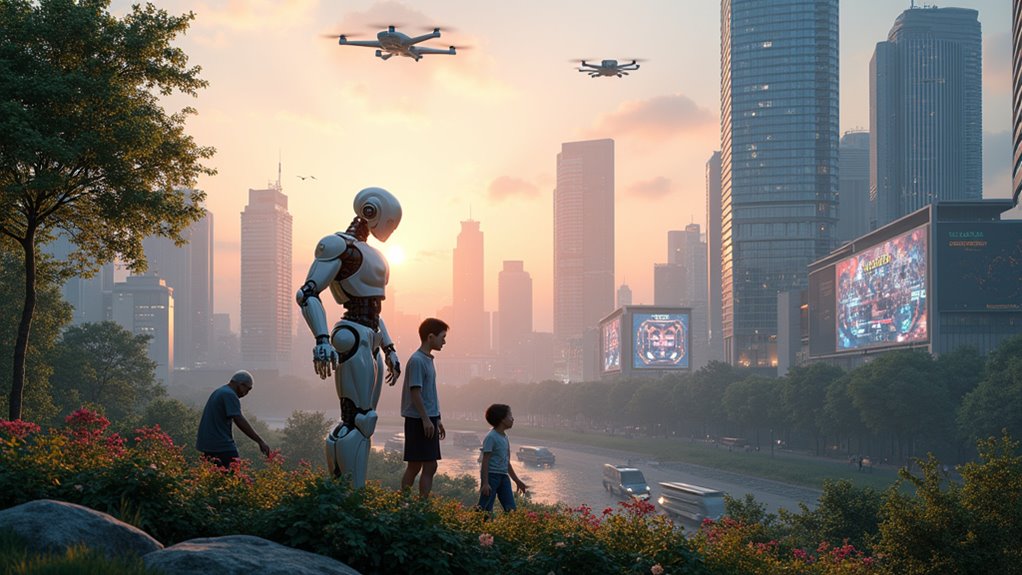

Design Highlights
- SoftBank CEO emphasizes the inevitable integration of AI into daily life, enhancing emotional support and decision-making processes.
- The rise of AI companions is expected to reduce loneliness and improve mental well-being across various demographics.
- Robots are increasingly utilized in logistics and healthcare, indicating a shift towards a collaborative working environment with humans.
- AI’s role as a digital coworker will expand, assisting with tasks while humans maintain strategic oversight for efficiency.
- Challenges such as cybersecurity and job displacement must be addressed to ensure a smooth transition into an AI-coexisting society.
What happens when humans and AI start sharing their lives more closely? A lot, apparently. SoftBank’s CEO is predicting an AI-coexisting society is just around the corner. And who can blame him? AI emotional companions are sprouting up everywhere, providing everything from academic coaching to elder support. They’re like that friend who never judges your Netflix choices and always has something encouraging to say.
These digital pals help reduce loneliness and improve mental well-being. But let’s not kid ourselves—there’s a dark side. Dependency is a real concern. Who wants to be that person who can’t even make a decision without consulting their AI BFF?
AI companions can brighten our days, but beware of becoming too reliant on your digital sidekick for decision-making.
Meanwhile, robots are sliding into everyday life like they own the place. With better sensors and mobility, they’re becoming the silent workers in logistics, healthcare, and even hospitality. You might bump into one while strolling down the sidewalk or waiting in a hospital.
Sure, they make life easier, but policy makers are scratching their heads over how to keep everyone safe. Are we ready for a world where robots might take our jobs? Spoiler alert: it’s not just about the robots; it’s about the humans learning to work alongside them.
In workplaces, AI agents are sprouting up as digital coworkers. They’re crunching numbers and generating content faster than you can say “synergy.” Humans still steer the strategy, but AI is the one doing the heavy lifting. AI is extending its role beyond diagnostics to include symptom triage and treatment planning, providing valuable assistance in managing health and wellbeing.
It’s a partnership that sounds great on paper, but trust is key. If AI agents are going to be part of the team, they’d better come with robust security measures.
But let’s not forget the research world. AI is turbocharging scientific discovery, taking on tasks like suggesting experiments and running them autonomously. You could say it’s the ultimate lab assistant—one that never takes coffee breaks.
Yet, as with all great advancements, there’s a catch. Security challenges loom large. Organizations are struggling to keep up, especially small businesses. Just as renters need personal property coverage to protect their belongings from unexpected risks, businesses must safeguard their digital assets in an AI-driven world.
Meanwhile, larger companies invest heavily in AI tools to stay ahead. The gap between the secure and vulnerable is widening. Brand trust is now tied to cybersecurity.