
Design Highlights
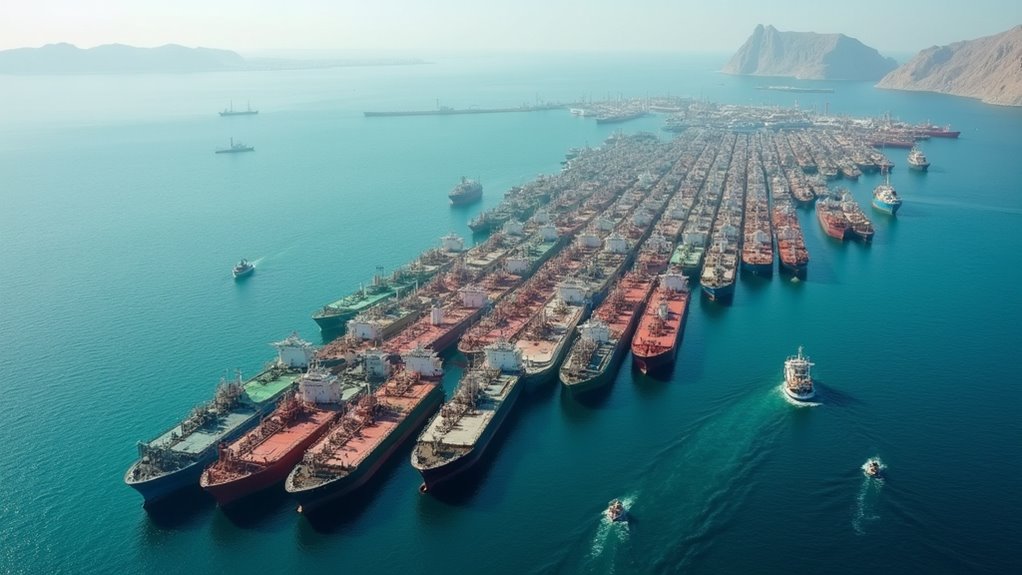
- Over 200 tankers are currently trapped in the Persian Gulf, causing severe maritime congestion and substantial financial losses.
- Oil flows decreased by 86% on March 1, with only 3 tankers transporting 2.8 million barrels.
- The Strait of Hormuz is crucial, carrying nearly 20% of the world’s daily oil consumption.
- War risk insurance for tankers has doubled, leading to a 35% hike in freight rates amid rising tensions.
- Delivery delays threaten global supply chains and escalate oil prices due to the ongoing traffic jam.
Oil tankers are clogging the Persian Gulf like traffic on a Friday night—except this jam is costing billions. Over 200 tankers, a mix of crude and clean product carriers, are stuck in a massive queue, with 334 crude oil carriers alone waiting for their turn. It’s not just a few ships in trouble; there are 706 non-Iranian tankers caught on either side of the Strait of Hormuz. Talk about a maritime mess.
Oil tankers are piling up in the Persian Gulf, creating a costly maritime logjam with over 200 vessels stuck in limbo.
On March 1, oil flows plummeted a staggering 86%. Just three measly tankers managed to transit, hauling a pathetic 2.8 million barrels. Compare that to 15 tankers on February 27 that moved 21 million barrels. What happened? A giant slowdown, that’s what. Vessel transits dropped by 81% in just a week. It’s like a ghost town out there, but a ghost town that still has bills to pay.
Now, let’s not forget the Strait of Hormuz. This narrow passage is a lifeline, carrying nearly 20% of the world’s daily oil consumption—around 20 million barrels per day. Countries like Saudi Arabia, Iraq, and the UAE depend on this strait for their oil exports. Meanwhile, the Strait of Hormuz is crucial for moving substantial volumes of liquefied natural gas (LNG), adding to its strategic significance.
Iran exports 1.6 million barrels daily through the same route, mainly to China. But now? They’re all stuck, and the strait is turning into a parking lot. The threat of missile attacks has further escalated risks for vessels trying to navigate through the region.
Insurance rates are soaring, too. War risk insurance has doubled, and freight rates for tankers have jumped 35% in just a day. Imagine trying to ship your oil at that rate! They’re advising vessels to avoid the area or delay their transits entirely. Who wouldn’t want to deal with that chaos? Just like how driving records can spike insurance premiums for motorists, operational risks are now forcing shipping companies to pay through the nose for coverage.
Vessels are clustered all over, with some stuck in the Arabian Sea holding 12 million barrels, just sitting there, no discharge destinations in sight. Nearly 10% of the mainstream VLCC tonnage is trapped in the Middle East Gulf. That’s a lot of oil just sitting around doing nothing.
The market’s feeling the pinch. Delivery delays are expected, and global supply chains are under strain. LNG markets are at risk, too. With alternative pipelines having less than 3 million barrels per day capacity, the outlook isn’t pretty.
Oil prices are surging, and it’s all because of this traffic jam in the Persian Gulf. So, here’s to hoping they clear up soon—before the whole world runs out of gas.