
Design Highlights
- The closure of the Hormuz Strait has led to a dramatic drop in vessel traffic, creating severe shipping congestion on a vital global route.
- With 20% of the world’s oil trade passing through, oil supply is significantly threatened, causing Brent crude prices to surge.
- The Strait is crucial for 20% of global LNG trade, with alternative routes unable to meet current demand, impacting global energy supply.
- Economic losses exceed $4 billion daily, causing logistical delays and overwhelming ports, which disrupts supply chains across multiple industries.
- Fertilizer supply, crucial for agriculture, faces significant disruptions, risking price hikes and shortages that could affect global food security.
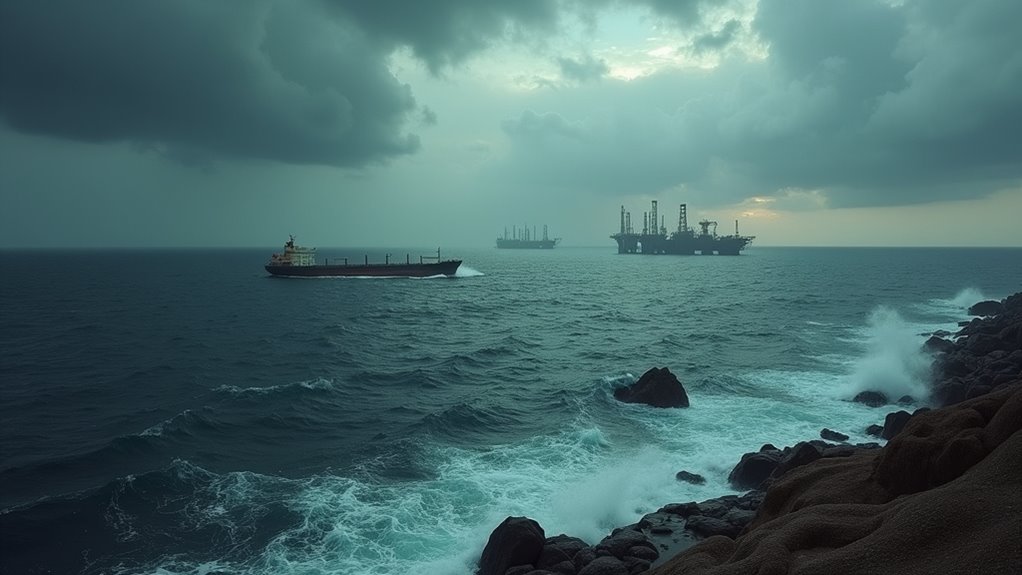
The Hormuz Strait is officially a shipping nightmare. This essential waterway, which normally handles a staggering 20 million barrels of oil and petroleum products daily—about 20% of the world’s oil trade—has turned into a major choke point. Since the Strait’s closure on March 12, 2026, vessel traffic has nearly ground to a halt. Just one lonely ship managed to pass through that day, a shocking drop from seven the day before. Daily transit averages plummeted from around 60 ships to, well, almost zero.
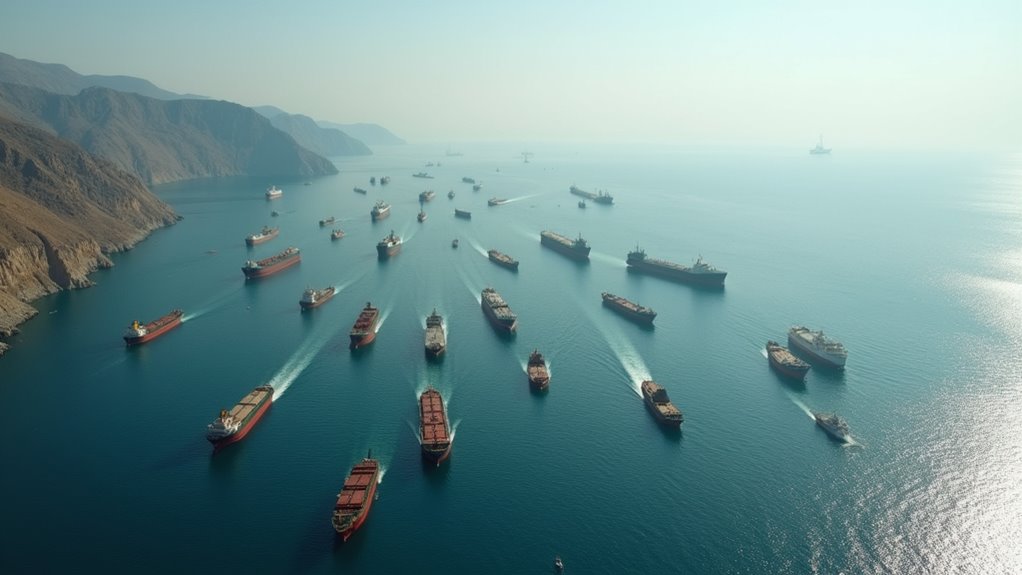
Now, over 150 vessels are stuck—some outside, some inside—like a bad game of musical chairs. These include tankers, bulk carriers, and commercial ships. And let’s not forget the chaos this has released: diversions surged by over 360% from an average of 218 daily transits to a whopping 1,010. In case anyone missed it, that’s not just a hiccup; it’s a full-blown traffic jam on the high seas.
Over 150 vessels are stuck, creating a chaotic traffic jam on the high seas with diversions surging by 360%.
Meanwhile, the impact on global oil prices is hard to ignore. Brent crude is soaring, and war risk insurance premiums are through the roof—over 16 times normal rates. Talk about a financial hangover. Crude and condensate loadings from the Middle East have fallen to 10.9 million barrels per day, down from 18.8 million just a month ago. Approximately 21% of the world’s oil supply is now at risk, with the closure declared by Iran’s Islamic Revolutionary Guard Corps exacerbating the situation.
But wait, there’s more! The Strait is also essential for liquefied natural gas. A hefty 20% of global LNG trade passes through here. Alternative pipeline capacities are laughably insufficient. Saudi Arabia’s East-West pipeline and the UAE’s Fujairah link can’t even come close to making up for the lost volume.
As shipments reroute to ports like Abu Dhabi and Dubai, operational delays are inevitable. Ports are scrambling to handle the influx of diverted freight, and it’s not pretty. The estimated daily economic cost has now exceeded $4 billion, further complicating the crisis.
And let’s not even start on the agricultural impact. About 40% of the world’s urea fertilizer flows through the Strait. Farmers worldwide could see price hikes or shortages because of these delays.
In short, the Hormuz Strait is no longer just a trade route; it’s now the world’s riskiest trade choke point. And it looks like it’s going to stay that way for a while. Buckle up, folks.