
Design Highlights
- The Strait of Hormuz currently sees only Iran-linked vessels, drastically reducing daily transits from 153 to just 13.
- A shipping standstill has persisted for over a week, causing critical bottlenecks in oil and gas exports.
- With storage tanks nearing capacity, regional refineries are cutting processing rates, impacting oil production in Iraq, Kuwait, and the UAE.
- Vessel diversions have surged over 360%, leading to congestion at alternative ports like Abu Dhabi and Hamad.
- Major carriers are scaling back operations, resulting in emergency surcharges and long-term implications for global trade logistics.
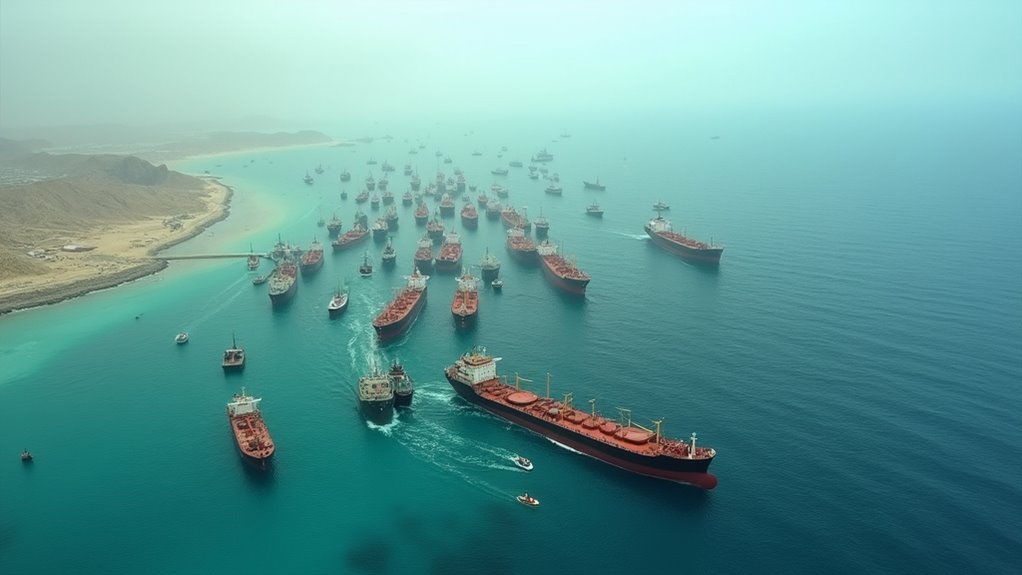
The Strait of Hormuz has become a maritime parking lot. It’s a chaotic scene out there. As of March 8, 2026, only Iran-linked vessels are making their way through this critical waterway. The last non-Iran-linked commercial ship, the Chinese-owned bulk carrier *Sino Ocean*, slipped through on March 1. Since then? Crickets. A shipping standstill has dragged on for seven straight days.
Traffic has plummeted from a pre-conflict average of 153 transits per day to a measly 13. That’s a drop to just 8% of normal volume. Talk about a bottleneck.
Traffic has nosedived from 153 daily transits to a dismal 13—just 8% of normal volume, creating a major bottleneck.
Storage tanks in the region are bursting at the seams due to an export blockade. Refineries are already cutting back on processing rates. Iraq, Kuwait, and the UAE are slashing production in response to the chaos, while Saudi Arabia is working overtime to boost shipments through its Red Sea export terminals.
It’s a wild game of musical chairs, and the music has stopped.
Tanker availability is another headache. Only nine empty supertankers were left in the Gulf by March 7. Meanwhile, a staggering 114 oil, chemical, and LPG tankers are anchored in the Gulf of Oman, with 79 of them sitting there empty.
The situation is getting worse, folks. There’s a serious strain on export logistics, and the limited number of available tankers is crippling operations. How’s that for a logistical nightmare? Oil tankers are unable to move due to the halt in shipping. Cargo owners facing losses from the disruption may want to explore whether their standard policies cover weather-related and disaster-driven damages to transported goods.
Diversions have surged over 360%. From a baseline of 218 per day, we’re now looking at 1,010. Vessel traffic patterns have been heavily impacted by the Strait’s closure.
The Mediterranean Shipping Company (MSC) is leading the pack, diverting 59% of all shipments. Ports like Abu Dhabi and Hamad are becoming the new hotspots for diverted freight.
Meanwhile, Mundra and Navi Mumbai are seeing departure delays soar—Mundra’s delays are up by 72%, while Navi Mumbai is experiencing an 118% increase. It’s a mess, and it’s not getting better anytime soon.
Carriers are feeling the pinch, too. Companies like Cosco and Hapag-Lloyd are scaling back their Middle East Gulf operations. Since February 28, 655 cargo-carrying ships have been spotted off UAE ports.
Emergency surcharges are popping up like weeds in a garden. The chaos in the Strait of Hormuz is more than just a traffic jam; it’s a critical chokepoint teetering on the brink. Buckle up, because it seems like this ride is far from over.