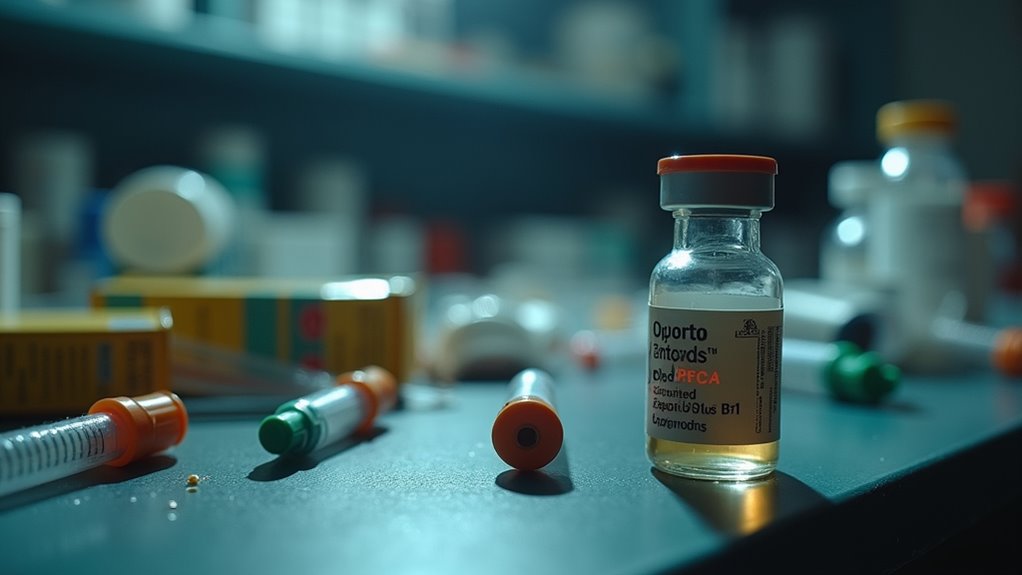

What’s really going on with compounded Zepbound plus B12? Well, let’s just say it’s a bit of a mess. Recent testing has highlighted some serious issues. Turns out, when tirzepatide mixes with certain B12 variants, it creates a significant impurity. And yes, that impurity comes with unknown toxicity levels. Fun, right? The FDA didn’t even evaluate this chemical incompatibility when it was reviewing these compounds. The culprits? Methylcobalamin, hydroxocobalamin, or cyanocobalamin. All of them can create high impurity levels, according to Lilly’s testing.
Compounded Zepbound plus B12 is a ticking time bomb, mixing tirzepatide with B12 variants that produce harmful impurities.
In an open letter, David Hyman, Lilly’s chief medical officer, didn’t mince words. He warned about the potential safety risks linked to compounded tirzepatide mixed with B12. B12 is reactive and, shockingly, it hasn’t gone through any rigorous clinical testing or FDA review.
As if that’s not enough, Lilly’s ongoing testing has also unearthed bacterial contamination and alarmingly high endotoxin levels in these compounded products. And let’s be clear: these compounding pharmacies are not getting any FDA approval for safety, effectiveness, or quality.
Now let’s talk about the FDA’s stance. They resolved the tirzepatide shortage in late 2024, but that doesn’t mean pharmacies can just compound it willy-nilly. They’ve been prohibited from routine compounding, except in certain medical cases, like allergies. Compounded Zepbound can have wildly varying inactive ingredients, and cost isn’t considered a valid reason for compounding. So much for that!
As of July 31, 2025, the FDA received 545 adverse event reports linked to compounded tirzepatide. These reports include everything from nausea and vomiting to more severe issues that required hospitalization. Dosing errors? Oh, they’re a common theme—thanks to incorrect self-administration or miscalculations.
And let’s not forget: many of these events likely go unreported. Non-outsourcing pharmacies aren’t even required to submit reports. Independent patients sourcing compounded GLP-1 drugs on their own face risks similar to those of independent insurance agents who lack employer-sponsored protections and are left without critical safeguards.
Then there’s the issue of untested additives. Besides B12, other unproven substances like glycine and niacinamide are making their way into these compounds. There’s no proven clinical benefit for any of these additives, and ongoing surveillance has found endotoxin, bacterial contamination, and impurities in compounded products. Additionally, compounded tirzepatide is not evaluated for safety or effectiveness, leaving patients vulnerable to potential harm.
And when combined, who knows what kind of short- and long-term effects they might cause? The uncertainty is staggering.
With all these impurities and unknowns, pressure is mounting against mass GLP-1 compounding. It seems like a recipe for disaster, doesn’t it?