
Design Highlights
- China’s “Justice Mission 2025” military exercises are the largest to date, simulating a blockade of Taiwan’s major ports.
- The drills include live-fire operations, anti-submarine exercises, and strikes on maritime and aerial targets, showcasing diverse military capabilities.
- This show of force follows a significant U.S. arms package to Taiwan, indicating heightened tensions in the region.
- Taiwan perceives these exercises as a threat to international order, prompting increased collaboration with allies like the U.S. and Japan.
- The encirclement strategy raises concerns about potential conflict escalation and the future dynamics of military confrontations around Taiwan.
What exactly is China up to with its latest military exercises around Taiwan? Well, the Eastern Theatre Command has launched “Justice Mission 2025,” just 11 days after the U.S. dropped an $11.1 billion arms package on Taiwan. Coincidence? Probably not. This marks the sixth round of military drills since 2022, and it’s the biggest one yet—spanning a vast area and getting uncomfortably close to Taiwan. They really seem to be making a statement here.
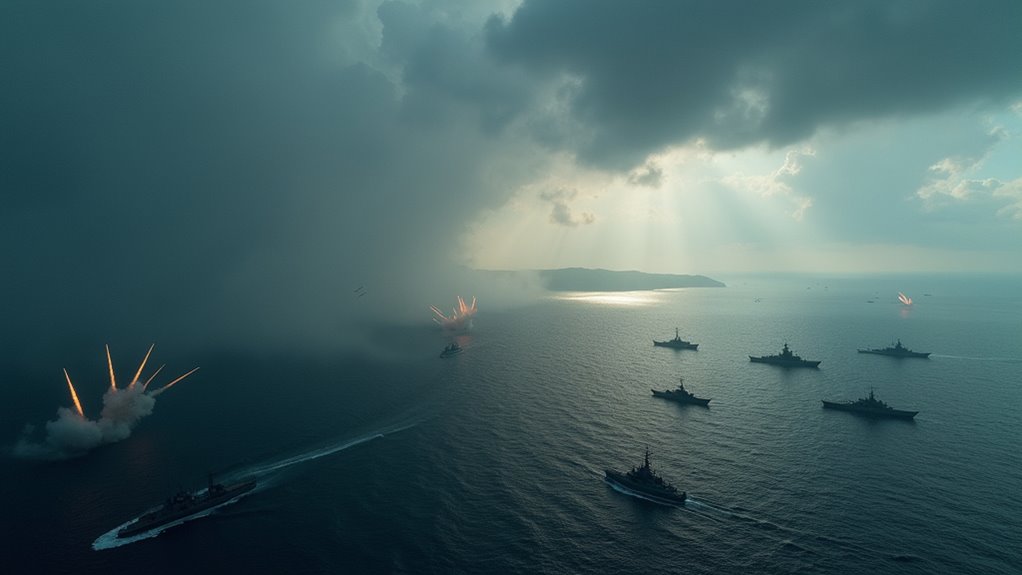
The exercises include 10 hours of live-fire drills, rocking the northern and southern waters around Taiwan. Picture it: live-fire rocket launches, simulated strikes on maritime and aerial targets, anti-submarine drills, and combat-ready patrols by both navy and air force. They’re not just flexing their muscles; they’re showing how many ways they can throw a punch.
And let’s not forget the three-dimensional outer perimeter interception. You know, just in case they need to catch a rogue drone or two.
A key focus of these exercises is a simulated blockade of Taiwan’s major ports—Keelung and Kaohsiung. Talk about a power move! They’re practicing how to seize control over critical regions, rehearsing with amphibious assault ships, bombers, and warships. The goal? To master the art of strangling Taiwan’s lifelines, effectively isolating the island. If that doesn’t sound like a message, what does?
The strategic objectives are clear: deter any external forces from intervening in the Taiwan issue. This is a show of strength. They want to verify their joint operational capabilities, too. Approaching Taiwan from multiple directions for combined assaults is all part of the plan. They’re even simulating strikes on land-based targets like U.S. HIMARS systems. Just a little reminder that they could take Taiwan by force if they really wanted to. China aims to ensure victory in a Taiwan conflict by 2027. The drills include various military maneuvers and strategic assessments to gather intelligence on Taiwan’s response tactics.
Taiwan isn’t just sitting back, though. They’ve accused China of undermining international order and noted the grayzone harassment via aircraft and warships.
Meanwhile, they’re teaming up with the U.S., Japan, the EU, and G7 to maintain stability. Because, you know, it’s always good to have friends when the neighborhood bully is acting up. Much like how Special Enrollment Periods allow for flexibility during significant life changes, geopolitical events can trigger shifts in military alliances and strategic partnerships.
In short, China’s military exercises around Taiwan are nothing short of a defiant display of power. And the world is watching, wondering what comes next in this high-stakes game of chess.