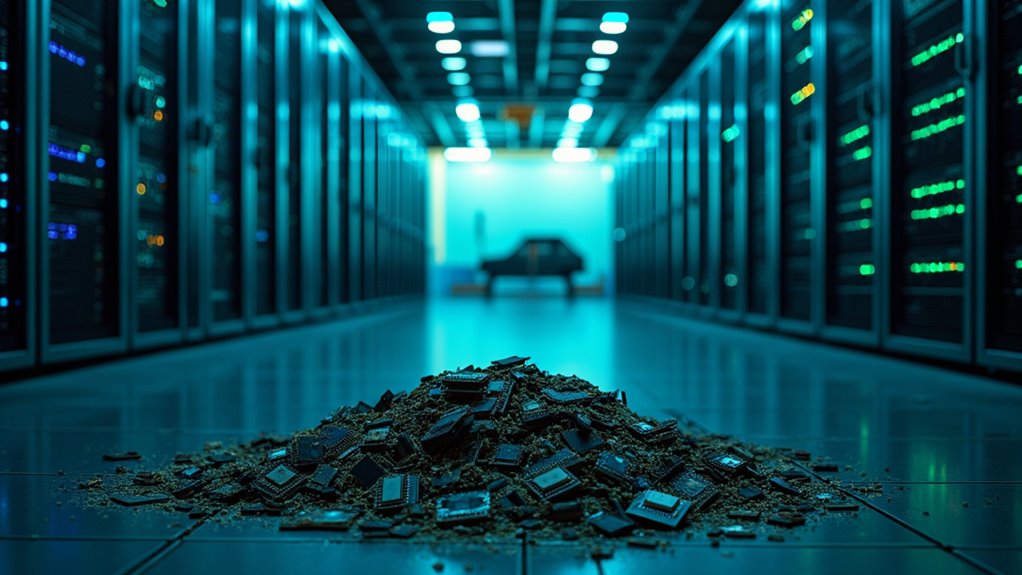

Design Highlights
- Data centers, driven by AI workloads, dominate memory chip consumption, diverting resources from other sectors like automotive.
- Hyperscalers’ open-ended orders prioritize memory production for AI, sidelining global carmakers in the chip supply chain.
- The rise in HBM production further reduces standard DRAM availability, exacerbating shortages for consumer electronics and automotive sectors.
- Chip shortages have led to significant disruptions in vehicle production, with car manufacturers struggling to access necessary memory components.
- Anticipated market fallout from rising memory prices and shortages threatens both tech and non-tech industries, including automotive.
As the world hurtles toward 2026, it’s becoming painfully clear that data centers are not just the backbone of the digital age—they’re the voracious monsters consuming an eye-watering 70% of global memory chips.
That’s right, folks. These beasts are chomping down on memory like it’s a never-ending buffet. And what’s fueling this insatiable appetite? AI workloads. They’re driving demand through the roof, leaving other sectors gasping for breath.
Hyperscalers, think Google, Amazon, Microsoft, and Meta, are placing open-ended orders without a care for cost. Who needs a budget when you’re in a tech gold rush? OpenAI’s Stargate project alone requires 900,000 wafers each month, eating up 40% of the global DRAM output.
Meanwhile, your average smartphone and PC makers are left scrambling. AI servers need way more memory than your run-of-the-mill consumer device.
And guess what? HBM production isn’t helping the situation. High-bandwidth memory is the hot new kid on the block. It demands more wafer capacity than standard DRAM, so manufacturers like Samsung are diverting their resources. They’re ramping up HBM4 production at the expense of your typical consumer lines. HBM production requires more wafer capacity than standard DRAM, leading to a contraction in DDR4 and DDR5 supply.
So, if you thought you’d get that shiny new gadget anytime soon, think again.
A global memory shortage has been brewing since 2024, and it’s only getting worse. Prices are shooting up like a rocket, with SK Hynix hiking prices by up to 70% compared to the previous year. Memory chip demand is expected to lead to significant market fallout across various sectors.
Omdia is forecasting memory industry revenue to surpass $400 billion in 2026. That’s an 80% jump! And you know what? It’s not just the tech giants feeling the pinch.
The automotive sector is starving for chips too. With all this prioritization for AI data centers, global carmakers are getting choked out of the supply chain. The strategic timing of these massive infrastructure investments has created unprecedented disruption across traditional manufacturing sectors.
What about consumer electronics? IDC predicts a 5% dip in smartphone sales and a 9% drop in PC sales—tough luck, right? Companies can’t compete for memory supply, and AI PCs now demand a minimum of 16GB RAM, with many shifting to 32GB+.
It’s a mess, really.