
Design Highlights
- The S&P 500’s market-cap weighting favors a few mega-cap tech stocks, exposing your portfolio to concentration risk during downturns.
- With 63% of earnings growth reliant on tech, any sector struggles could significantly impact S&P 500 performance.
- A high CAPE ratio of around 37 suggests potential for muted returns, increasing the risk of underperformance in the coming years.
- Equal-weight S&P 500 funds offer more stability and can reduce concentration risk compared to traditional market-cap weighted ETFs.
- Diversifying beyond large-cap U.S. stocks into mid-, small-cap, or bond ETFs can enhance your portfolio’s resilience against market volatility.
When it comes to investing in the S&P 500 ETF, it’s easy to get swept up in the hype. Everyone’s talking about it, right? But here’s the kicker: this market-cap weighted index is like a popular club where only the big shots get the VIP treatment. Larger companies, especially in tech, hog all the attention and resources. So, you might think you’re diversifying, but in reality, you’re just riding the coattails of a few mega-cap stocks. If those giants stumble, good luck finding your balance.
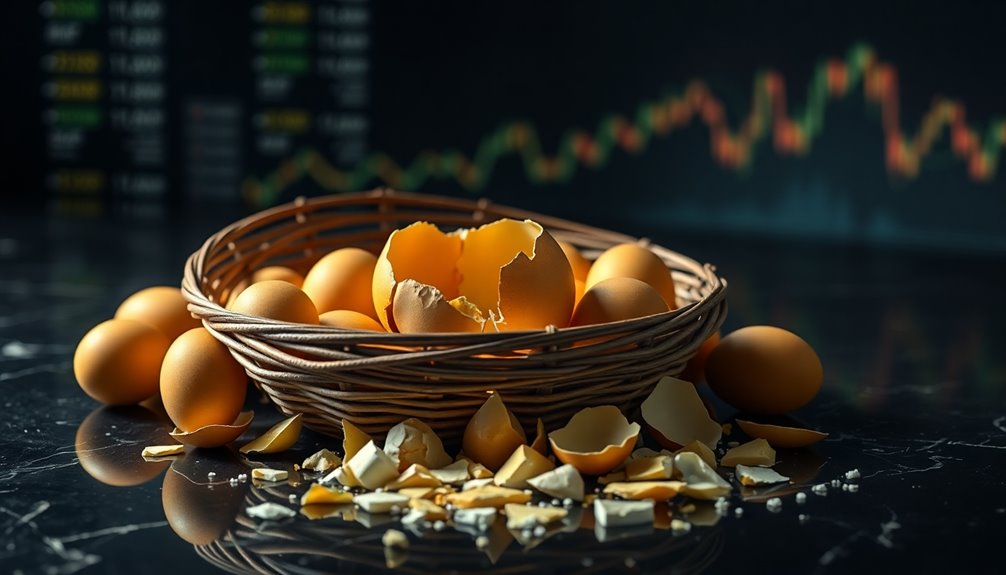
Let’s get real: the recent gains in the S&P 500 have been driven by a handful of large stocks. Sure, ETF.com mentions that the contributor list is widening for 2026, but c’mon! Just look at the numbers. Information Technology companies are expected to account for a staggering 63% of S&P 500 earnings growth. That’s a lot of eggs in one basket, folks. When that leadership falters, your supposedly broad-market ETF can turn into a rollercoaster ride of disappointment.
And speaking of disappointment, have you checked the valuation lately? SSGA calls 2026 “uncomfortably bullish,” and with good reason. The S&P 500 is sitting at a CAPE ratio of around 37. That’s high—really high. If earnings take a nosedive or interest rates don’t play nice, you’re left holding the bag. Investing in a premium-priced index could mean muted returns, even if the underlying companies keep chugging along. S&P 500 ETFs have delivered average annual returns of about 10% over nearly a century, but that doesn’t guarantee future performance.
Now, let’s talk about tech dependence. The S&P 500’s heavy tech exposure can make it feel like a ticking time bomb. When tech stocks soar, the index can look fantastic. But when they dip? Ouch. The volatility can be brutal. It’s not the “safe” core holding everyone wants it to be. You’re exposed to the same macro shocks hitting those big tech players, and that’s not exactly comforting. Moreover, major tech firms are significantly involved in AI, which presents both opportunities and potential risks.
So, what’s the alternative? Equal-weight S&P 500 funds can help reduce that concentration risk. They might lag behind the cap-weighted index over five years, but at least they didn’t dive as hard during the 2022 bear market.
Diversifying beyond a single U.S. large-cap index can help you avoid being crushed by the weight of a single sector’s struggles. Mid- and small-cap value stocks, bond ETFs, and Treasury bill ETFs are all worth considering. Beyond investments, everyday financial decisions matter too—for instance, bundling home and auto insurance can yield discounts between 10% and 25%, freeing up more capital to diversify your portfolio.
In the end, relying solely on an S&P 500 ETF could quietly sabotage your portfolio in 2026. It’s a wild world out there. Don’t get caught off guard.