
Design Highlights
- The Northeast is the smallest U.S. region by area but boasts a diverse geography, including mountains and coastlines.
- With a population of 57.6 million, it is the most densely populated region, featuring significant urban areas like New York City and Boston.
- The region’s economy is robust, valued at $5.1 trillion, contributing about 23% of the nation’s GDP, primarily focused along the I-95 corridor.
- Historically rich, the Northeast combines over 10,000 years of Indigenous history with European settler influences, shaping its cultural landscape.
- Notable cities like New York and Philadelphia serve as cultural and economic hubs, driving innovation and diversity in the region.
Nestled snugly in the corner of the United States lies the Northeast, the smallest region by area but bursting at the seams with life. Covering just 181,324 square miles, it’s a compact patchwork of diverse geography. Think mountains, coastlines, and everything in between. Bordering Canada and the Atlantic Ocean, it’s both a gateway and a melting pot. Home to nine states, including the six New England states—Maine, New Hampshire, Vermont, Massachusetts, Connecticut, and Rhode Island—it’s a region that packs a punch.
With a population of 57.6 million as of the 2020 census, the Northeast is the most densely populated region in the country. That’s about 345 people per square mile. If you thought your hometown was crowded, try living in a place where the density is 2.5 times higher than the South.
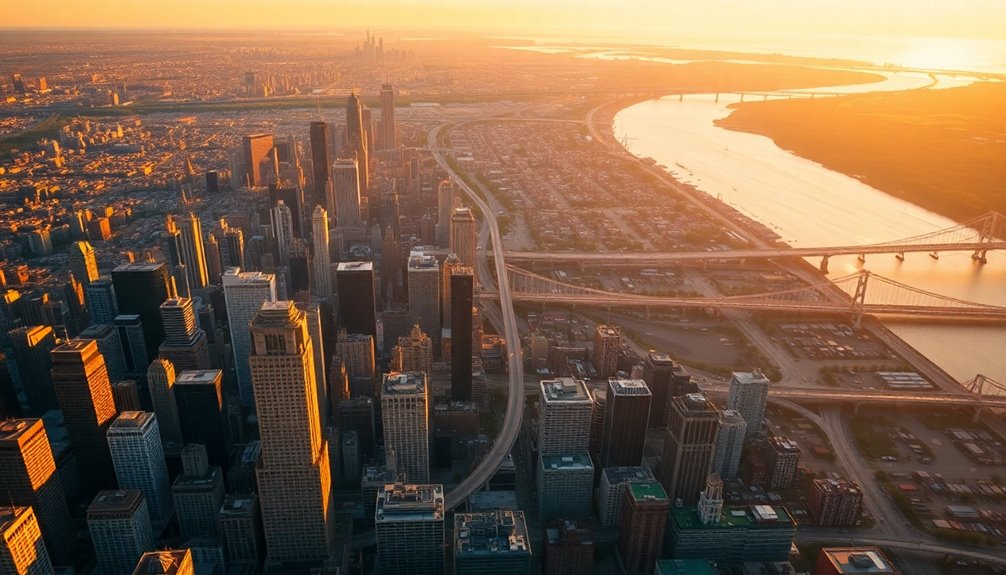
Most of these folks are crammed into the Northeast megalopolis, a bustling corridor that stretches from Boston to New York City and down to Philadelphia. Talk about a traffic jam.
Major cities here are iconic. New York City reigns supreme as the largest city in the U.S. and a global financial hub. Boston, with its rich history, has about 675,000 residents. Philadelphia? A heavyweight in its own right. It’s hard to ignore the cultural reverberations of these urban giants.
Even Providence, the capital of Rhode Island, manages to make its mark. And let’s not forget Portland, Maine, which might be the smallest, but it’s charming.
Economically, the Northeast is a powerhouse, boasting an economy worth a staggering $5.1 trillion in 2022. Most people live along the I-95 urban corridor, fueling a dense economic activity that’s hard to rival. New York City is the financial heart, pumping out jobs and money like there’s no tomorrow. It’s a place where ambition meets opportunity—if you can survive the commute. Approximately 23% of the nation’s GDP comes from the Northeast, showcasing its economic significance. The region is also known for its rich diversity across people, geography, and industry. The concentration of businesses throughout this corridor means that business insurance coverage is a critical consideration for the countless small and large enterprises operating in one of the world’s most competitive markets.
The region’s history is as layered as its geography. Indigenous groups thrived here long before European settlers arrived. The Pilgrims landing in Massachusetts in 1620 changed everything, disrupting Native life.
With over 10,000 years of Indigenous history, the Northeast has seen it all.
In short, the Northeast might be the smallest region in the country, but it’s a titan in its own right. A blend of history, culture, and relentless energy, it’s a place where life never seems to slow down.