Design Highlights
- Adopting fire-resistive features can lead to significant insurance discounts, improving affordability for homeowners in wildfire-prone areas.
- Building to the IBHS Wildfire Prepared Home Base standard can reduce average annual losses, making homes more insurable.
- Insurers increasingly favor homes compliant with evolving fire-safe standards, enhancing their marketability and lowering premiums.
- Homeowners in high-risk zones may avoid steep premium hikes by implementing proactive safety measures aligned with emerging building codes.
- Even without formal legislation, adopting best practices in wildfire resilience can influence insurers’ willingness to underwrite policies in vulnerable areas.
When it comes to wildfires, building codes and insurance are about as thrilling as watching paint dry—until they’re not. The reality is, the right building standards can save homeowners a lot of money. Take the IBHS Wildfire Prepared Home Base standard, for instance. Rebuilding to that standard can reduce average annual loss by a staggering 31 percent. And the WPH Plus standard? It takes that up a notch with a 35 percent cut in projected wildfire losses. That’s not just a marginal improvement; it’s a game changer for anyone living on the edge of a wildfire zone.
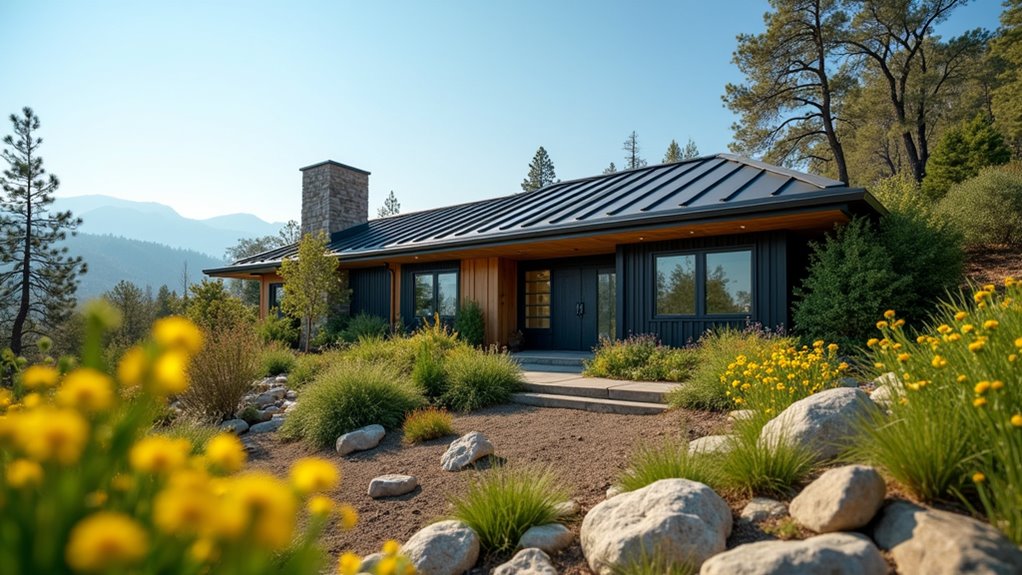
These standards aren’t just pie-in-the-sky ideas. They focus on practical aspects like roof protection, building features, and defensible space. That’s two tiers of safety designed to shield homes from flames, especially in areas like Palisades and Eaton fire zones in Los Angeles.
These practical standards emphasize roof protection and defensible space, providing essential safety for homes in wildfire-prone areas.
And let’s not forget Paradise, California, which adopted these measures as its rebuilding benchmark after the catastrophic 2018 Camp Fire. Talk about learning the hard way.
But it doesn’t stop there. Insurance premiums are another beast entirely. After the fire, residents in Paradise saw their insurance bills drop by a jaw-dropping 800 percent compared to the FAIR Plan. Yes, you read that right—800 percent.
Every little action homeowners take to make their properties safer can lead to insurance discounts. The more they do, the more they save. It’s like a twisted game of “how low can you go?” And guess what? Homeowners in high-risk zones are still paying over 80 percent more in premiums than those in safer areas. Unfair? Absolutely.
Insurers are getting skittish about wildfire risks. They’re hiking premiums, refusing to renew policies, or outright leaving high-risk areas. The Durango Fire Protection District faced this ugly reality in 2024, with some insurers canceling policies altogether. For broader financial protection beyond property damage, homeowners should also understand that standard liability limits in most insurance policies typically range from $100,000 to $300,000, with umbrella policies available for additional coverage.
Insurers are now pushing for construction standards that include fire-resistive features. In California, the response has been to pair resilient ordinances with FEMA grants. This combination has lured insurance companies back to Paradise, but only for those who follow fire-safe standards.
In the broader picture, 60 percent of U.S. single-family homes built since 1990 are in wildland-urban interface zones. That’s a staggering amount of at-risk housing. Homeowner insurance lacks sufficient market influence to address development in fire-prone land, making the need for improved building practices even more pressing.
With California holding $761 billion in at-risk development, it’s clear that rising wildfires are forcing changes in reinsurance, underwriting, and claims. Homeowners must pay attention. Ignoring these evolving standards could be a costly mistake.