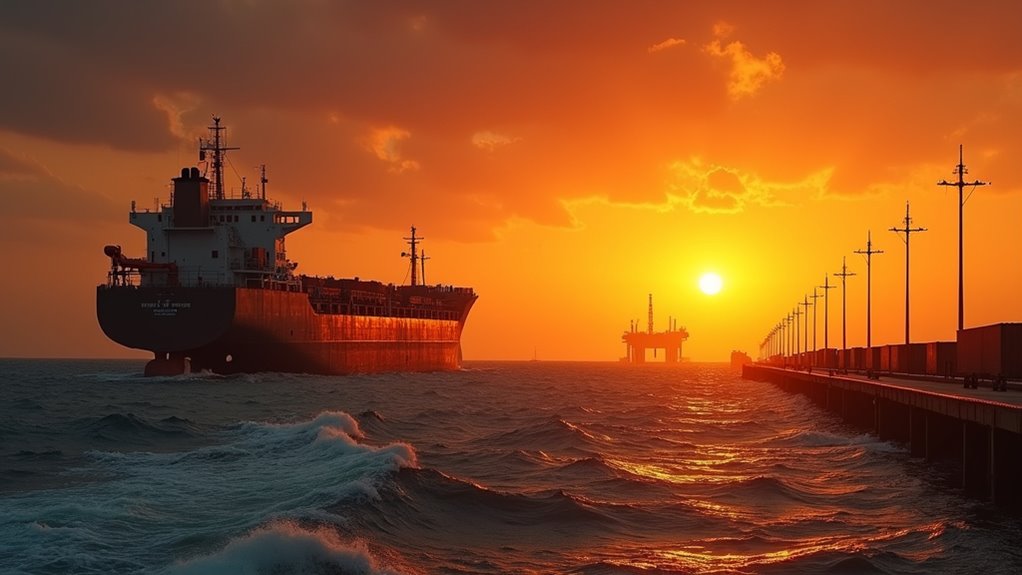

Design Highlights
- Rising military tensions in the region have led to increased demand for robust Political Violence insurance among Gulf businesses.
- Insurers are withdrawing coverage for vessels in Iranian and neighboring waters, leaving businesses exposed to risks.
- The closure of the Strait of Hormuz has disrupted commercial traffic, heightening the need for protective insurance policies.
- Limited insurance options are driving companies to seek state guarantees for adequate coverage in high-risk environments.
- Existing policies are proving inadequate, prompting a shift towards broader Political Violence coverage to address emerging threats.
In the wake of the recent military strikes by the US and Israel on Iran, the Persian Gulf has turned into a minefield for businesses. Suddenly, insurance companies have hit the brakes on war risk coverage for vessels in the region. The reason? Tehran decided to throw a wrench in the works by shutting down the Strait of Hormuz to commercial traffic. It was like a domino effect—cancellation after cancellation, especially for Iranian and neighboring waters. What was once a manageable political violence risk has morphed into a multi-jurisdictional nightmare for insurers.
With the escalation between the US, Israel, and Iran, private insurers are now playing hard to get. They flat-out refuse to underwrite policies in Iranian and nearby waters. As a result, fleets are left floating around uninsured. Talk about a bad situation! Meanwhile, businesses in the Gulf are scrambling for cover. Data centers, energy projects, and even hotels are rushing to insurers for millions in political violence coverage. It’s like a game of “who can shout the loudest,” but the stakes are sky-high. State guarantees are becoming the new must-have as private insurers pull out of the game. The cancellation of war risk coverage is forcing companies to rethink their strategies in the face of rising tensions.
Private insurers are retreating, leaving Gulf businesses scrambling for vital political violence coverage amid escalating tensions.
The aviation sector isn’t safe either. Airports in Dubai and Kuwait are under threat, with carriers from Doha forced to park planes as a precaution. It’s a scene straight out of a disaster movie, but it’s all too real. Landmark assets, typically insured through specialized programs, are now vulnerable. It’s a new demand in a market that had never seen anything like this before.
Interestingly, amidst all this chaos, around £350 million of new capacity has entered the market thanks to Lloyd’s syndicates and specialist underwriting agencies. This influx is driving competition, allowing brokers to offer premium savings for clients. What a twist! After years of a hard market dominated by large-scale incidents, this softening is a welcome change. But the broader insurance sector? It’s expected to remain pretty insulated from the fallout.
However, gaps in coverage are glaring. Strikes and Terrorism policies aren’t cutting it for the threats of the last few years. Political Risk Insurance is limited, covering specific events but leaving reputational damage and regulatory changes unprotected. More buyers are turning towards a broader scope of Political Violence cover. It’s a sign of the times. Businesses that fail to regularly review and update their policies risk being caught off guard, as comprehensive policy reviews can reveal critical gaps before a crisis strikes.
In the Gulf, businesses are learning the hard way that security isn’t just a luxury—it’s a necessity. Prolonged campaign increases the likelihood of repeated incidents, underscoring the urgent need for comprehensive coverage.