
Design Highlights
- ESA and Liberty Mutual Re are enhancing parametric insurance by utilizing satellite data for more efficient disaster response.
- Instant payouts are triggered by specific environmental parameters, eliminating delays from traditional assessments.
- Satellite technology offers global coverage and reliable data, especially in remote areas lacking ground data.
- The integration of AI and machine learning improves predictive capabilities and underwriting processes in climate insurance.
- ESA’s initiatives support scalable solutions, increasing accessibility and attractiveness of climate insurance across diverse populations.
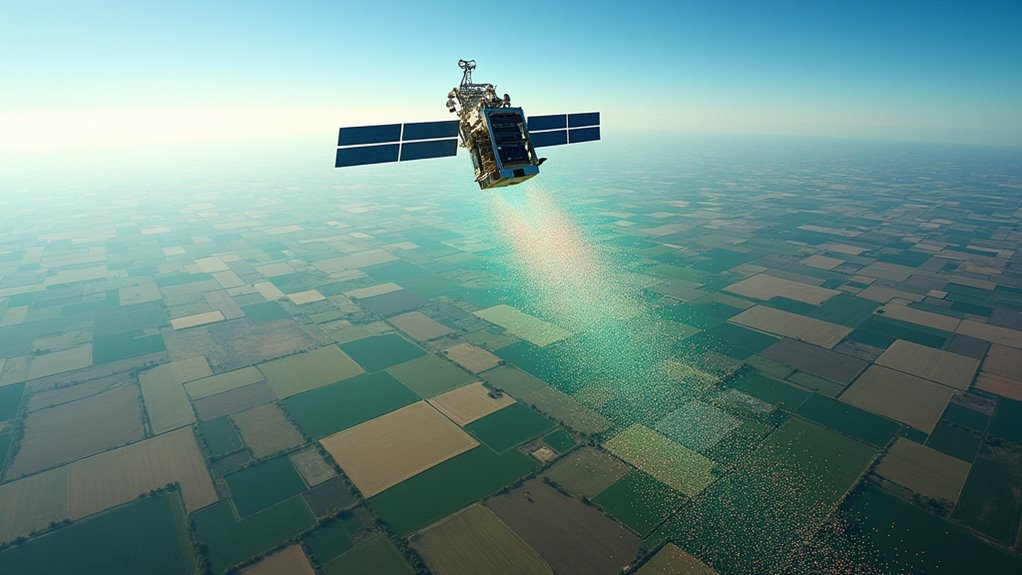
Climate insurance is getting a major facelift, thanks to the wonders of space data. Enter the European Space Agency (ESA) and Liberty Mutual Re, teaming up to turn the cosmos into a solution for climate risk. Their mission? To transform parametric insurance using satellite data. This isn’t just tech-savvy; it’s downright revolutionary. Instead of waiting for adjusters to assess damage—yawn—payouts happen instantly when specific parameters are met. Think flood levels or hailstone size. You reach a threshold, and bam! Cash flow.
Climate insurance is evolving, leveraging satellite data for instant payouts—no more waiting for adjusters!
This approach addresses the inefficiencies of traditional indemnity insurance, where lengthy assessments can leave folks hanging. Who wants to wait for help when disaster strikes? Not farmers, that’s for sure. Parametric insurance sidesteps the problems of adverse selection and moral hazard, since payouts depend on indices beyond individual control. It’s like having a safety net that actually works—an efficient way to transfer climate risk. Like choosing between term and permanent policies in life insurance, parametric products offer flexibility tailored to specific financial goals and risk management needs.
Satellite technology is the unsung hero here. With global coverage, satellites analyze every nook and cranny of Earth’s surface. They fill in the gaps where ground data is either scarce or non-existent, especially in remote areas. And when you combine this data with AI and machine learning? You get predictions that actually match past weather patterns. Consistency is key, unlike those unreliable ground stations that seem to fail when you need them most. Scotland’s expertise in space data is attracting international companies like Weather Stream, further enhancing the capabilities of climate data analytics. This dynamic integration of Earth Observation datasets provides insurers with consistent, decision-ready inputs for accurate risk assessment.
ESA’s Business Applications and Space Solutions (BASS) initiative backs this transformation. Their BirdsEyeView’s RAPTOR software harnesses Earth Observation datasets for underwriting. It’s not just fancy jargon; it’s a game changer. The pilot program exceeded targets, modeling hazards across 28,000 locations. That’s how you scale!
Applications for agriculture are equally exciting. NASA and IRI are working together to create scalable datasets for farmers in Africa. Vegetation indices and rainfall estimates can trigger payouts, ensuring farmers aren’t left in the lurch when drought hits. With a time series of over 30 years, these datasets support thousands of farmers.
Geospatial property intelligence is another feather in the cap. It automates underwriting, speeds up pricing, and, get this, reduces the manual process time by 40%. This is what efficiency looks like, folks.
In a world grappling with climate change, this innovation is not just smart; it’s necessary. Scotland is positioning itself as the space data capital, and insurers are paying attention. With space data, the future of climate insurance looks brighter—faster payouts, lower premiums, and less waiting around. Who wouldn’t want that?