
Design Highlights
- Alliant Insurance Services was selected after a rigorous RFP process against three other major brokers specializing in large-scale construction projects.
- Their expertise in New York City’s regulatory environment played a crucial role in their selection as the insurance broker for the project.
- Alliant’s effective negotiation strategies resulted in significant cost savings for the MTA, saving 2-3% of the estimated construction value initially.
- The brokerage’s prior involvement with MTA’s Capital Plan OCIPs demonstrated their capability and reliability in managing large infrastructure projects.
- Their comprehensive approach to risk management was essential in addressing the complexities associated with the $2 billion subway project.
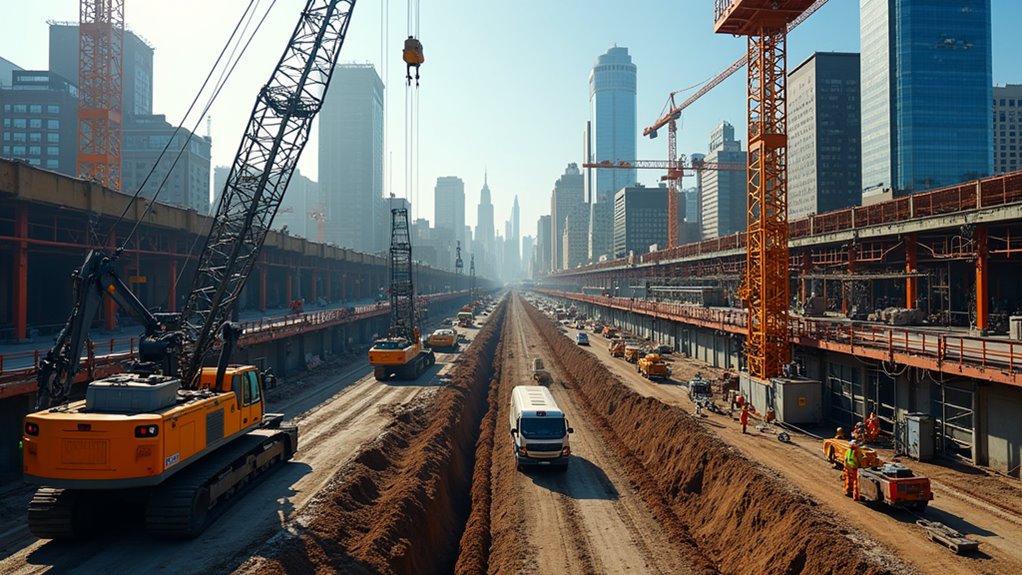
When it comes to the Second Avenue Subway Phase 2 project, things are finally moving—well, sort of. With a whopping $2 billion price tag, this mammoth undertaking intends to extend the Q train from 116th Street to 125th Street in East Harlem and Central Harlem. Not exactly a small feat, right? The tunnel work kicked off in September 2025 and is expected to wrap up over the next four years. If all goes according to plan—fingers crossed—the revenue service date is set for September 2032. Yes, 2032. Talk about a long wait.
The Second Avenue Subway Phase 2 is finally underway, with a $2 billion extension set for 2032.
In the midst of this massive endeavor, the Metropolitan Transportation Authority (MTA) has selected Alliant Insurance Services as their insurance broker. Chosen after a rigorous RFP process against three other major brokers, Alliant’s expertise in large-scale NYC construction projects clearly won them the job. They’re not new to this game; they’re already handling the MTA’s Capital Plan OCIPs 1 and 2. So, they know the ropes and how to navigate the complex regulatory environment that comes along with it.
On the contractual side, the MTA awarded a $1.972 billion design-build contract to Connect Plus Partners, a joint venture between Halmar International and FCC Construction. This is the second of four construction contracts for the Q train extension, and it includes some serious excavation work for the future 125th Street Station. A new tunnel will be constructed between 116 Street and 125 Street, which will be a significant component of the project.
Oh, and they’re even retrofitting the 1970s tunnel for 116th Street Station, which will save a cool $500 million. Who doesn’t love saving money?
Thanks to Alliant’s savvy negotiating, they managed to save the MTA an impressive 2-3% of the estimated construction value on the initial OCIP. They’re projecting over $2 billion in total cost savings over the next four years. And let’s not forget the $500 million saved by the outfitting measure.
And somehow, they’re keeping the entire Phase 2 project on budget, which is set at $6.99 billion. It’s like a miracle, really. This project is partly funded by Congestion Relief Zone tolling revenues. Because what better way to fund a subway than by taxing drivers?
Throughout this whole process, MTA Chair Janno Lieber expressed gratitude for the progress made for Harlem communities. After nearly a century-long wait for East Harlem subway service, it’s about time something good is happening. Given the scale and complexity of the project, comprehensive property and casualty insurance coverage will be essential to protect against unexpected risks like equipment damage or construction-related liability claims.
Alliant is right in the thick of it, managing risks and complexities like pros. Can’t wait to see how this all unfolds.